
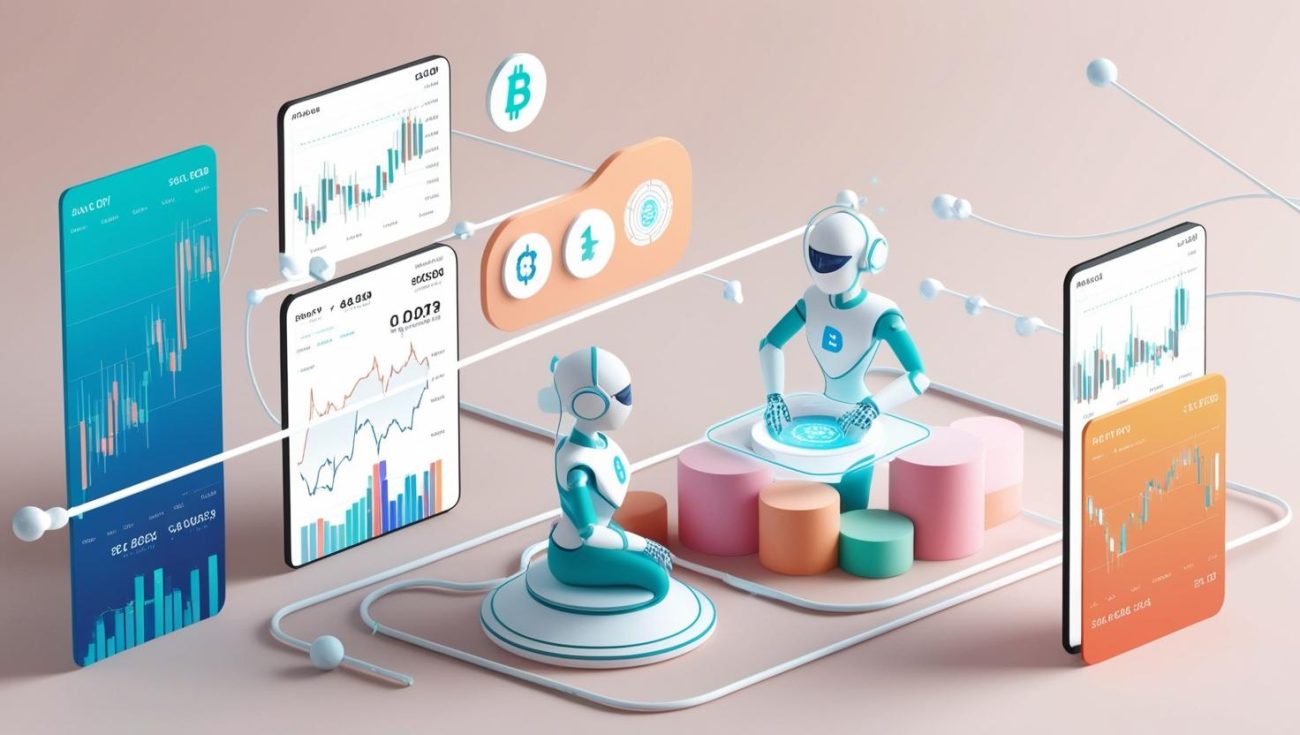
In the nascent, often chaotic, yet undeniably vibrant realm of Decentralized Finance (DeFi), capital flows like a torrential, silver river seeking the steepest descent—the highest return. It is a landscape of complex contracts, ephemeral liquidity pools, and variable yields, a domain where human intuition, though crucial, is often outpaced by the sheer velocity and volume of market data. The challenge is not merely to find yield, but to optimize it—to navigate the treacherous, ever-shifting currents of impermanent loss, fluctuating gas fees, and dynamic interest rates.
Enter the Algorithmic Alchemist: Artificial Intelligence, specifically the nuanced tools of Machine Learning (ML).
I. The Labyrinthine Market: A Need for Superior Vision
DeFi protocols, such as liquidity pools (e.g., Uniswap, Curve) and lending platforms (e.g., Aave, Compound), are fundamentally optimization problems veiled as financial services. A liquidity provider seeks to maximize their share of trading fees while minimizing the dreaded impermanent loss (IL). A yield farmer aims to perpetually reposition assets across different protocols to capture the highest real Annual Percentage Yield (APY) net of transaction costs.
For a human, this task is Sisyphean. It requires continuous monitoring of:
- Protocol Metrics: Real-time APY, utilization rates, and collateralization ratios.
- Market Data: Token prices, volatility, and correlation.
- Blockchain State: Gas prices, transaction latency, and block times.
This is where the ML model steps in, not as a mere calculator, but as a hyper-aware oracle.
II. The Tools of the Alchemist: Machine Learning Applications
The application of ML in yield optimization is multi-faceted, leveraging techniques that transcend simple rules-based automation.
1. Predictive Modeling for Impermanent Loss (IL)
Impermanent Loss is the phantom thief of DeFi, a risk that haunts all liquidity providers (LPs). IL arises from the relative price change of the pooled assets.
- The ML Approach: ML models, particularly Recurrent Neural Networks (RNNs) or Long Short-Term Memory (LSTM) networks, can be trained on historical price data, volume, and volatility metrics to forecast future price divergences between assets in a pool.
- The Outcome: The model can generate a “Risk-Adjusted IL Score” for a given pool, advising the LP when to withdraw assets before a predicted high-divergence event occurs, thus maximizing the fee accumulation while minimizing the loss potential.
2. Dynamic Yield Aggregation and Rebalancing
Yield aggregators (often called “vaults” or “optimizers”) automatically move funds between different DeFi platforms to maximize returns. Current models often rely on a simple threshold or a scheduled rebalance.
- The ML Approach: Reinforcement Learning (RL) is the perfect paradigm for this challenge. The RL agent observes the state (current APYs of all protocols, current gas price, locked-in capital) and chooses an action (e.g., move 10% of capital from Aave to Compound). The reward is the realized net yield after gas fees.
- The Outcome: The RL agent learns an optimal “rebalancing policy” that is not dependent on fixed schedules but rather on the predicted future state of the market and the current cost of the transaction. For example, the agent might delay a high-yield move if gas prices are momentarily prohibitive, anticipating a drop or a better opportunity shortly after.
3. Risk Management and Anomaly Detection
The greatest threat to yield is the black swan event—a smart contract exploit, an oracle failure, or a sudden market crash.
- The ML Approach: Isolation Forests or Autoencoders can be deployed to continuously monitor transaction patterns, capital flows, and protocol health indicators.
- The Outcome: An anomaly in a protocol’s internal metrics (e.g., a sudden, unnatural spike in withdrawal volume from a single address) triggers an immediate protective withdrawal or a re-evaluation of the protocol’s security score within the yield optimizer’s portfolio. This transforms risk management from a static audit into a dynamic, real-time defense.
III. The Literary Echo: The Evolution of Financial Stewardship
The integration of AI into DeFi is more than just a technological upgrade; it is a philosophical shift in financial stewardship. The old Wall Street mantra was “greed is good”; the new algorithmic imperative is “efficiency is supreme.”
The ML model, devoid of human bias, emotional panic, or cognitive fatigue, represents the ultimate, tireless portfolio manager. It sees the market not as a battlefield of rivals, but as a complex system of differential equations that must be solved continuously.
The true elegance of this fusion lies in the principle of democratization. These sophisticated optimization strategies, once the exclusive domain of quantitative hedge funds, are being baked directly into the smart contracts of public protocols. The Algorithmic Alchemist is creating an open financial landscape where the pursuit of optimal yield is not reserved for the few, but is an automated, efficient service available to all who can connect a wallet.
This convergence transforms the yield farmer from a manual laborer into a capital allocator, leveraging the machine to till the digital fields while they focus on the next great horizon of decentralized innovation. The future of DeFi is not just decentralized; it is algorithmically optimized.