
The growth of decentralized finance (DeFi) and Web3 has made smart contracts the foundational building blocks of the digital economy. These self-executing contracts, with the terms directly written into code, manage billions of dollars in assets. However, their immutable nature is a double-edged sword: a single unpatched bug or vulnerability can lead to catastrophic, irreversible losses.
Historically, smart contract security relied heavily on manual auditing—a slow, expensive, and fallible process. Today, Artificial Intelligence (AI) is stepping in to transform this critical sector, providing automated, scalable, and highly accurate analysis to secure the code that underpins the future of finance.
The Auditing Challenge: Why Manual Review Isn’t Enough
The complexity and sheer volume of smart contracts being deployed daily have far outpaced the capacity of human auditors. The challenge is threefold:
- Complexity: Smart contracts, especially those governing complex DeFi protocols, involve intricate logic and interactions with external contracts, making manual verification highly susceptible to human error.
- Scale and Speed: The demand for new protocols requires rapid deployment, but thorough manual audits can take weeks. This often creates a trade-off between security and time-to-market.
- Subtle Vulnerabilities: Exploits often hide in subtle coding logic or known patterns that AI is better equipped to recognize across massive datasets of previously exploited code.
This is where AI-powered auditing tools offer a necessary evolution, leveraging machine learning and static analysis to enhance both the speed and depth of security checks.

How AI Elevates Smart Contract Security
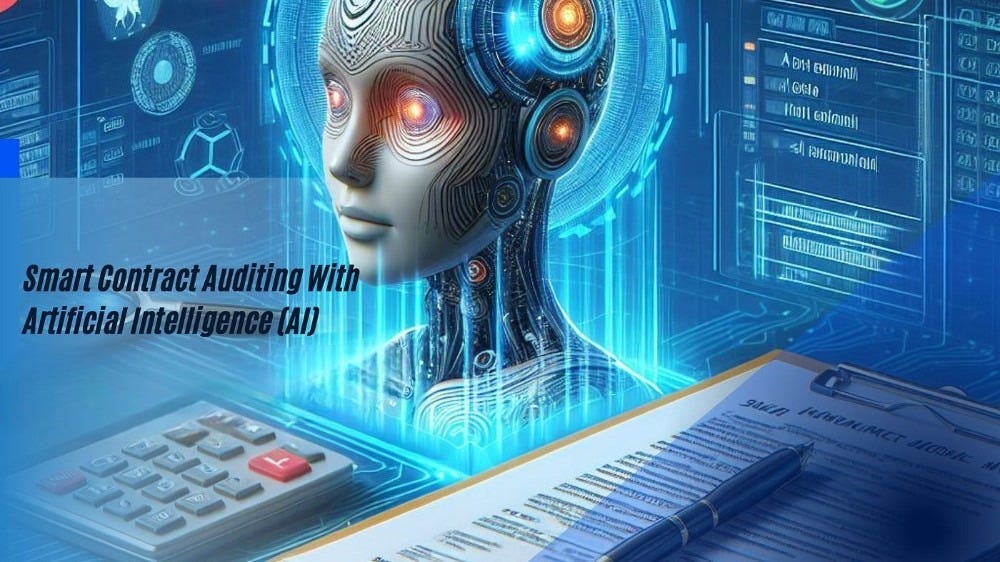
AI-driven tools primarily function by performing automated code analysis, learning from millions of lines of existing code and historical exploits to detect vulnerabilities that might escape human eyes.
1. Static Analysis and Pattern Recognition
AI models excel at Static Analysis, which means examining the code without executing it.
- Vulnerability Detection: The AI is trained on a massive corpus of secure code and insecure code, allowing it to recognize risky patterns such as reentrancy flaws, integer overflows, denial-of-service attack vectors, and timestamp dependence.
- Zero-Day Exploit Identification: By recognizing anomalous code structures that deviate from secure standards, AI can potentially flag “zero-day” vulnerabilities—previously unknown flaws that haven’t been documented in public databases.
2. Formal Verification Assistance
Formal Verification is the process of mathematically proving that a system’s code satisfies its specification (i.e., that the code does exactly what it’s supposed to do and nothing else). This is the gold standard for security, but traditionally requires significant manual effort.
- Automating Proof Generation: AI models can assist developers and security engineers by automatically generating the necessary mathematical properties and constraints, significantly reducing the time and expertise required to perform rigorous formal verification.
3. Fuzz Testing and Dynamic Analysis
While static analysis checks the code structure, AI also enhances Dynamic Analysis through techniques like fuzz testing.
- Intelligent Fuzzing: The AI doesn’t just throw random data at the contract; it uses reinforcement learning to intelligently generate inputs most likely to trigger a failure or vulnerability (e.g., specific transaction sequences or extreme input values), testing the contract’s resilience under stress.
Key Benefits of AI-Powered Auditing
The integration of AI into the auditing pipeline offers clear advantages for developers and investors alike:
| Benefit | Description |
| Speed and Scale | AI tools can scan millions of lines of code in minutes, enabling continuous security checks rather than periodic audits. |
| Consistency | Automated tools eliminate human fatigue and bias, ensuring every line of code is checked against the same rigorous standards every time. |
| Cost Efficiency | By automating the initial, time-consuming stages of audit, AI significantly reduces the overall cost of security. |
| Comprehensive Reporting | AI provides detailed reports pinpointing the exact location and nature of vulnerabilities, accelerating the developer’s patching process. |
The Future: A Collaborative Approach
It’s important to note that AI is not replacing the human security expert; it is augmenting them. The most effective security strategy involves a collaborative approach:
- AI Pre-Audit: Automated tools quickly scan the code, flag all known and potential issues, and generate a vulnerability report.
- Human Verification: Senior security researchers then review the critical findings flagged by the AI, focusing their expertise on complex logic flaws, protocol economics, and cross-contract interactions that require nuanced human understanding.
- Formal Verification (AI-Assisted): Mathematical proof is generated for the core logic, often with assistance from AI tools.
By delegating the repetitive, pattern-recognition heavy work to AI, human auditors can focus their valuable time on the most critical, high-impact areas, resulting in a deeper, faster, and more secure audit process. This shift is essential for building a robust and trustworthy Web3 ecosystem.